
Lone Star Review:
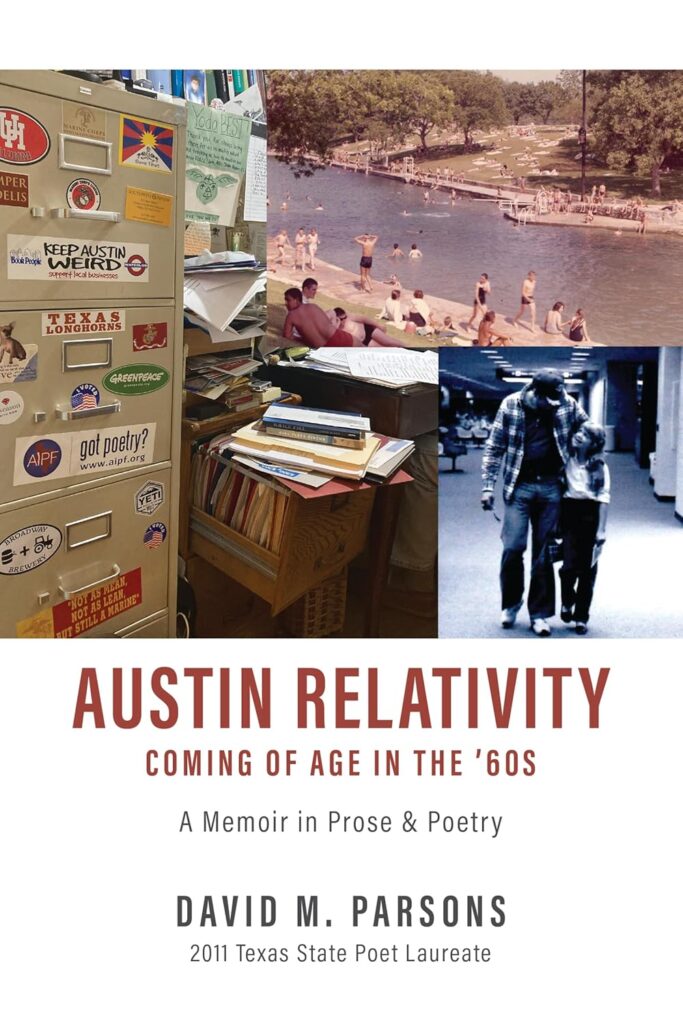
AUSTIN RELATIVITY
Coming of Age in the '60s
A Memoir in Prose & Poetry
New poetry by David M. Parsons
Reviewed by Janet McCann
Austin Relativity, Coming of Age in the ’60s. A Memoir of Prose and Poetry
David M. Parsons
I’ve read a lot of autobiographies and memoirs lately, and my favorites are always deeply imbued with the sense of place. In the best of them, this element is so ingrained that it seems the person could have grown up nowhere else. David Parsons’s book has Austin, Texas visible all through it, like a stick of Brighton Rock. Wherever readers come from, this book will give them a deep sense of what an Austin upbringing beginning in the 40s must have been like. Parsons’ experiences cover all of central Texas, and his memoir reflects this range.
I am also used to reading accounts by those who were rejected by their communities and schools—and sometimes even their families—who then went away to become famous scientists or whatever. But Parsons fit into his native setting perfectly. All the escapades experienced by young men growing up in Texas at that time were part of his life. The people we think of as prototypical Texans were his friends. He breathed in Texas and it helped form him, so that he ultimately became its spokesman, and in fact, its Poet Laureate.
The narrative is a series of close-up snapshots. It goes from scene to scene, person to person, showing the development of the young man who grew up to be a poet, a professor, and the Poet Laureate of Texas. Some of the people and places are illustrated by strong poems that engage the reader’s mind and heart. Some of these poems and scenes are funny and some are devastating.
It’s an unusual format because the reader gets the narrative of what happened as well as how the poet received it and turned it into poetry. It is worthy of study by poets, especially those who are trying to articulate their places in the world and to bridge the gap between memory and art.
I feel these poems especially strongly as a transplanted Texan. I arrived in College Station 1967 to teach at Texas A&M University and never left. The tower shootings at University of Texas had taken place not long before my arrival, and, of course, everybody was still talking about them. Parsons gives a direct account from direct experience, as he sat at a nearby bar, Scholz’s Beer Garden, and observed the tragic event, He follows it with a poem that reanimates all the old shared feelings and images of that time.
From the poem:
that very air here again now—the gamey
smells of the Dutchman’s beer garden
the carefree summer women
laughing braless in loose tie-dyes
the capital dome
topped with Lady Liberty
and UT’s apex and bastille of education
and there now…and again—white puffs—…
Sniper! Sniper!
Girls first! diving under
stone gray concrete tables
towering turquoise sky
ragged clouds…
And from the narrative, after describing some of the deaths of those he knew:
When I think of her and the other victims, 14 fatalities and 32 wounded, I am reminded of the lasting impact on their lives and the many adjacent lives of their friends and families. And I remember that we who were witnesses naively thought that the random shooting was a bizarre anomaly in our nation’s history…
The persona that emerges in these vignettes is honest and caring. He recounts the trials and tragedies of his life and those in the lives of his friends and family well as all the high points. But he does not indulge in gloom or hostility. Rather, we get a picture of a thoughtful, reflective man of action—a person we would like to meet.
The photos and other illustrations add to the experience. Some have the mysterious romance of old photos, and others seem very recent. Happily they’re spread through the book and not clustered in the middle, which gives the reader a chance to connect narrative, poem, and picture.
The specifics are marvelously evocative for those of us who know these Texas scenes, and they probably have a vibrancy even to those who don’t. A lot of us mourn the disappearance of the Austin of the ‘60s and ‘70s. Only odd little pockets of it remain now, and they too will soon be gone. Austin Relativity gives us space to remember and regret, but also to celebrate the fruits of Austin’s past. It will delight and transfix many readers.