
New nonfiction by Kirk Ward Robinson
A sweeping, resonant examination of courage as both personal virtue and national legacy
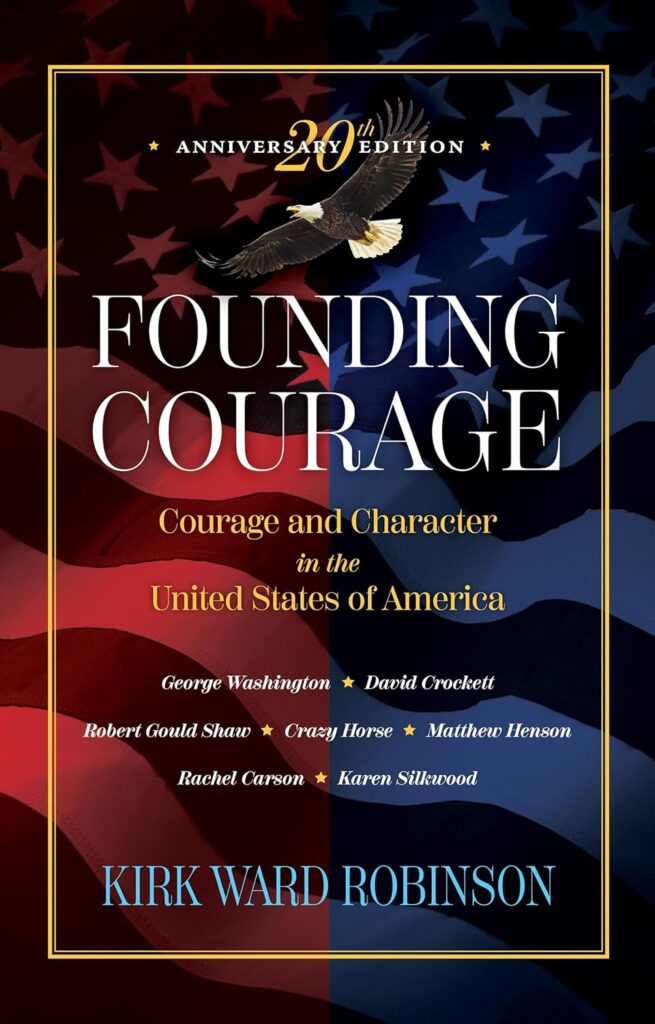
Kirk Ward Robinson’s Founding Courage returns in a twentieth-anniversary edition with a renewed sense of urgency, inviting readers to consider what courage has meant across American history—and what it might still mean today. Robinson approaches the subject with an unmistakable seriousness, blending scientific inquiry, historical portraiture, and philosophical reflection into a narrative that aims to illuminate not only the nature of courage but also its place in shaping national character.
The book opens with a careful examination of the biology and psychology underlying courageous behavior. Robinson walks readers through the hormonal cascades and neurological processes that prepare the body for decisive action, then pivots toward the higher-order forces—experience, moral identity, altruism—that transform physical response into character. These early chapters are dense but purposeful, laying the groundwork for the larger argument that courage is both universal and deeply individual, accessible to everyone yet fully realized only when rooted in personal conviction.
From this foundation, Robinson widens the lens to consider the American story itself. His narrative here is often lyrical, even cinematic, especially when describing the dangers and uncertainties that have tested successive generations. He does not shy away from pointed observations about modern American life; his critique of contemporary fear, political posturing, and eroded public trust is frank and, at times, bracing. Some readers will welcome this directness, while others may wish for a more nuanced treatment. Still, Robinson’s intent is clear: to propose that courage has not disappeared but has been overshadowed by noise, and that reclaiming it requires remembering where we came from.
The core of the book—its portraits of George Washington, David Crockett, Robert Gould Shaw, Crazy Horse, Matthew Henson, Rachel Carson, and Karen Silkwood—is where Robinson’s strengths are most evident. His research is meticulous, his pacing deliberate, and his prose attentive to the interior lives of his subjects. He avoids idealizing them, instead tracing how ordinary limitations, private doubts, and lived experiences shape extraordinary acts. Particularly compelling is his treatment of underrepresented histories: the layered context he offers in the chapters on Crazy Horse and Matthew Henson broadens the reader’s understanding of whose courage has been celebrated—and whose has long been overlooked.
At its heart, Founding Courage is less about elevating heroes than about examining the conditions that make heroism possible. Robinson writes with clear admiration but also with an insistence on accuracy, noting where myth has overtaken fact and where history deserves to be reexamined. The result is a work that feels both reflective and restorative.
Readers interested in American history, moral psychology, or character education will find much to engage with here. Robinson’s arguments may spark debate, but the book’s thoughtful structure and genuine reverence for its subjects make it a resonant exploration of what courage has meant—and what it still can mean.