
Lone Star Review:
WOUNDED WINGS: ONE MAN'S SECRET STRUGGLE
New memoir by Jeanne Donovan and Ronald I. Johnson
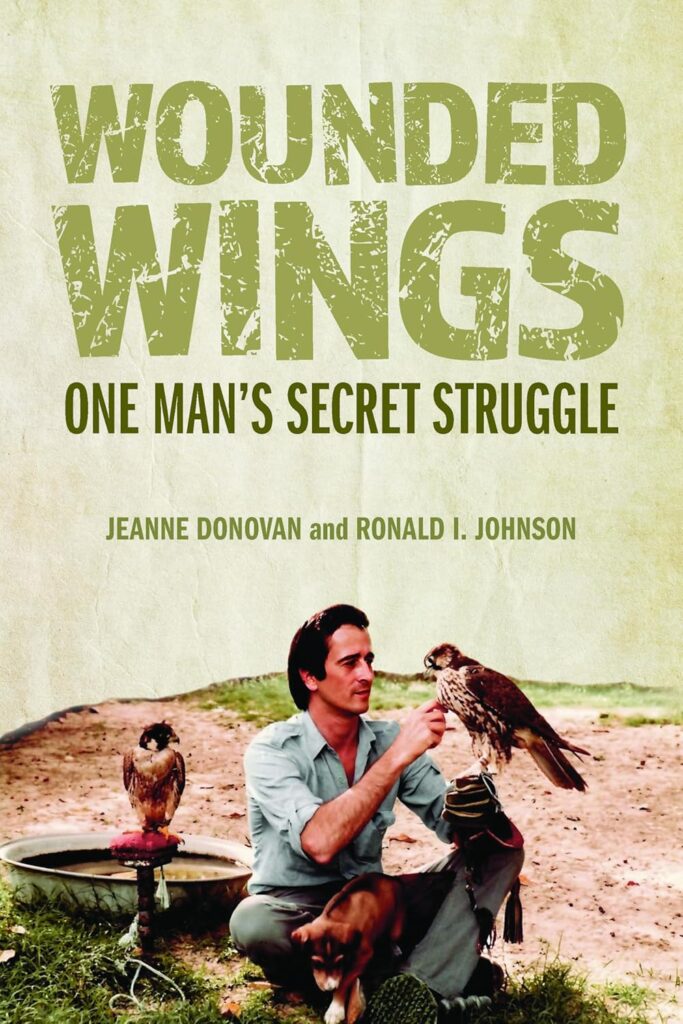
Reviewed by Maryann Miller
Jeanne Donovan and Ronald I. Johnson
Wounded Wings is the true story of Gilbert Johnson, brother and half-brother to the authors, Jeanne Donovan and Ronald Johnson. They write with frank openness and honesty about the struggles Gil faced throughout his life—struggles that likely influenced some of his poor choices in adulthood. He suffered mentally and emotionally from childhood sexual abuse, family instability, personal conflicts regarding his homosexuality, a religion that told him he was a sinner for loving another man, and creativity stifled by emotional turmoil.
While this is largely Gil’s story, Wounded Wings encompasses much more than one man’s life. In addition to biographical content, the book offers compelling histories of Iran and Saudi Arabia and the people who live there. Readers are given a close-up view of the Iranian Revolution, when protestors tore down statues of the Shah and “villagers boosted Gil and his team up on rooftops so they could film what was happening in the streets.”
Later in his career with the BBC, Gil was sent to Saudi Arabia. Accounts of his time there describe his harrowing journey across the desert, where roads could be covered in sand overnight and the team had to rely on the driver to “find the road in the new configuration of the sand.”
These passages draw readers in to experience the adventure alongside Gil.
Underpinning it all is an in-depth look at what years of sexual abuse—especially by a family member—can do to a child. The authors do an outstanding job presenting the complexities of all those elements, as well as the intricacies of their family dynamics. With a grandfather who sexually abused more than one family member, it’s no wonder the children and grandchildren struggled with emotional, mental, and spiritual dysfunction.
Gil was a truly tortured soul—not only because of the abuse, but also because of the biblical view of homosexuality held by so many religions in the 1960s and ’70s. While reading, my heart broke for the man who would “… pace his apartment with a Bible in hand, trying to find a way out of his spiritual dark hole.”
There is a stark contrast between the Gil who struggled at home in the U.S. and the Gil who seemed relaxed, happy, focused, and confident abroad while filming documentaries and writing articles. As he simply stated in one of the many letters included in the narrative, “I am happy here.”
In another letter, he describes the everyday people he met, such as the “laborers who line the streets in the early morning, leaning on their shovels, waiting for strangers to give them work for ten dollars a day, digging ditches or carrying rubbish. They’re all villagers, and they stand there holding hands and watching all the cars go by. Some are old and pock-faced, bent nearly double from years of hard labor, and some are young with generous smiles. I think they’re all beautiful…”
That final statement reveals the heart and soul of a man readers can embrace, like a beloved fictional character who finds joy in relationships and new friends.
Throughout most of the book, the narrative is compelling as Gil’s story unfolds. His essays from years of reporting, along with letters he wrote to family while traveling, bring his experiences to life. They’re written with such rich detail that it feels as if we’re standing beside him, seeing the people and places for ourselves. Gil’s descriptions of the desert—such as “the blue shadows of the valleys between dunes”—paint vivid visual scenes. That same attention to color, shape, and texture permeates his writing and helps explain why it was so well received.
The book ends with helpful chapters offering information about sexual predators—their types, how to identify them, and resources for further reading. These final sections verge on academic in tone, occasionally slipping into lecture-style language with phrases like “we have already covered … and now we will move on.” This wordage may feel dry, but the content remains valuable.
For parents, teachers, social workers, and psychologists, that information is a vital resource. And the preceding chapters are worthy of rereading for their rich discussions of AIDS, world history, Gil’s life, and much more.
Part memoir and part travelogue, Wounded Wings is a tribute to a beloved brother—woven with family history, social commentary, and personal reflection. It is highly recommended for readers who enjoy books that transport, inform, and move them all at once.