
Lone Star Review:
THE SLIP
New literary fiction by Lucas Schaefer
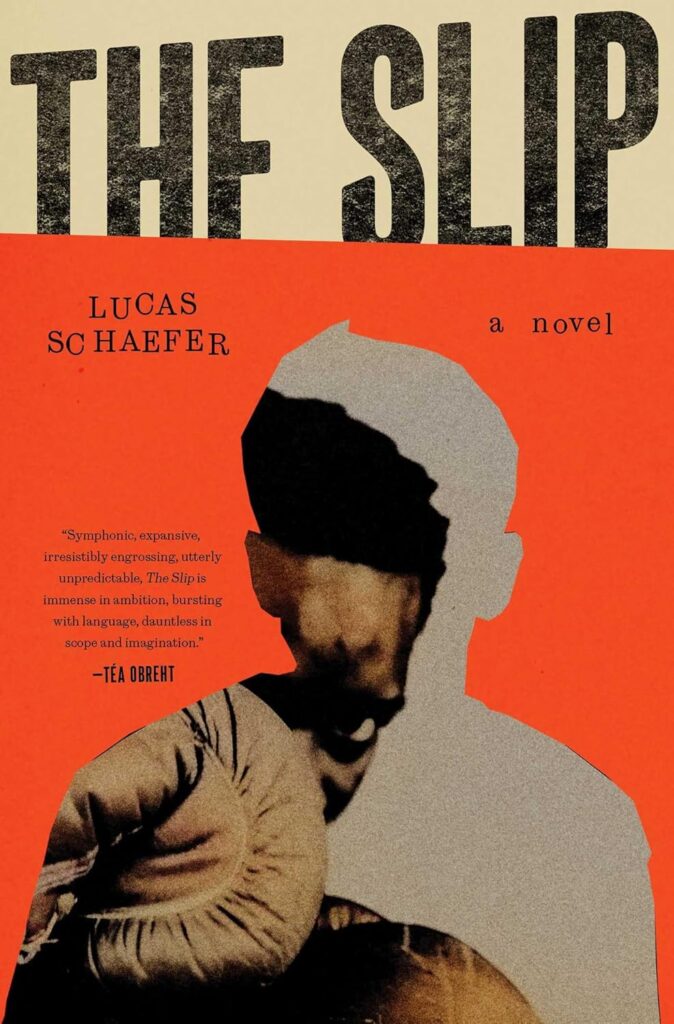
Reviewed by Juan Fernando Villagómez
The Art of Becoming: A Review of Lucas Schaefer’s The Slip.
Lucas Schaefer
Lucas Schaefer’s The Slip is a deep dive into the complex process of human “becoming.”
The book begins with the mystery of a missing boy, Nathaniel Rothstein. The disappearance pulses at the heart of the narrative, but the book is far from a conventional whodunit. The Slip, like its namesake boxing maneuver, evades and deceives the reader, moving back and forth in time, slipping seamlessly between perspectives, creating a wild chorus of characters all connected to an Austin, Texas, boxing gym. There’s a putzy Jewish boy from suburban Massachusetts; an old stoner college professor; an unsure Chicana police officer; an undocumented boxer; a transgender woman; a wounded coyote; a gay metalhead. Then there’s David Dalice, Nathaniel’s supervisor at the old folks’ home where he volunteers—and a former fighter who mentored the teenager in the boxing gym in the months leading to his disappearance.
David takes Nathaniel under his wing that summer—impressing the boy with his easy confidence, his gratuitously sexual banter, and his prowess in the boxing ring. With David as his mentor, Nathaniel gains confidence, starts getting fit, and begins dressing like David. He starts to wear cologne and begins to smell suspiciously like David. As the summer progresses, Nathaniel falls in love with Sasha, the girl on the other end of the phone sex hotline. After months of aural courtship, they agree to meet in person. There’s a problem, though: Nathaniel introduced himself on the phone to her as “David,” presenting himself as Black, as Haitian, and as a boxer.
One of The Slip’s greatest strengths is its ability to take on issues of identity—sex/gender, race, and citizenship—while transcending the easy and argumentative rhetoric that tends to exploit and politicize those markers of identity. So, when Nathaniel goes online to learn how to darken his skin, as he lies naked in the tanning bed at the local mall, as his complexion goes from pale to dark, the narrator does not condemn the boy. The novel instead works to understand him, mired in the difficulty of his experimenting, in the agonizing and bizarre process of his becoming. The book reminds us of our own awkward explorations—the way we try on new selves until something sticks, the way we fail, regret, long, and finally grow.
I had the opportunity to interview the author at Murder by the Book in Houston, Texas, on June 4. In our conversation, Schaefer revealed that the concept of stepping into another identity to discover one’s own is central to the novel—and it also mirrors the act of writing fiction.
“How do we find ourselves in other people?” he asks, reflecting on his twelve-year process of writing the novel. “David is very different from me in terms of demographics,” Schaefer says. “He’s Haitian. I’m a white Jewish kid from Newton, Massachusetts. But David has a pretty good life. A good job. He’s in a happy marriage. He travels a lot. He just hasn’t achieved his dreams. He didn’t become a boxer. He became the activities director of a nursing home. I was thirty when I first started the book. I understood David on an intellectual level. Then I’m thirty-five and I’m still working on the book while people around me are publishing and doing pretty well, and I’m still plodding away at the book. And then I’m thirty-seven and I’m plodding away, and then I’m thirty-nine and suddenly I thought, ‘If this doesn’t happen, I am David. I am doing fine. I have a happy marriage. Life is good. But I haven’t achieved my dream.’ In this process, I became David. If the book works,” the author says, “it’s because I’m able to embody David in a way that I wouldn’t have been able to do if I had written the book in a single year.”
The novel does work. It works precisely for the reason Schaefer points to. The Slip is not just a great feat of the imagination; it is Schaefer’s own story of persistence. That’s where the emotional resonance of the book lives—in its aching attention to the slow work of change. Picture the author writing and doubting, and writing and growing, and writing and doubting, and growing. Picture the boxers at Terry Tucker’s gym sweating, jabbing, feinting, slipping—getting better with every workout.
The Slip carries you through many characters’ “workouts.” And when you least expect it, the book squares up. It concentrates its power. It switches stance and hits you with a flurry of emotional gut punches that you realize you should’ve seen coming all along. Squinting through tears of joy, laughter, and the grief of letting go of the friends you grew with across nearly five hundred pages, the secret of Nathaniel’s disappearance comes into hazy view.
With The Slip, Lucas Schaefer has given us a novel that reminds us that literature can be about everything. It reminds us that, in literature, one can write about anything. The Slip’s big narrative voice fearlessly spans characters of such difference and diversity, it is no surprise that one of the author’s guiding questions while writing the book was: “How can we come together and find a shared humanity while also acknowledging all of these differences that we have?” Lucas Schaefer took twelve years to find that “how.” With The Slip, he unites us all under the common identity of becoming.